ML
MANA LEDGER
The financial terminal for your Magic: The Gathering collection — built around Secret Lair drops and preconstructed decks.
Free forever · No account · Your data never leaves your PC · Coming soon to Steam
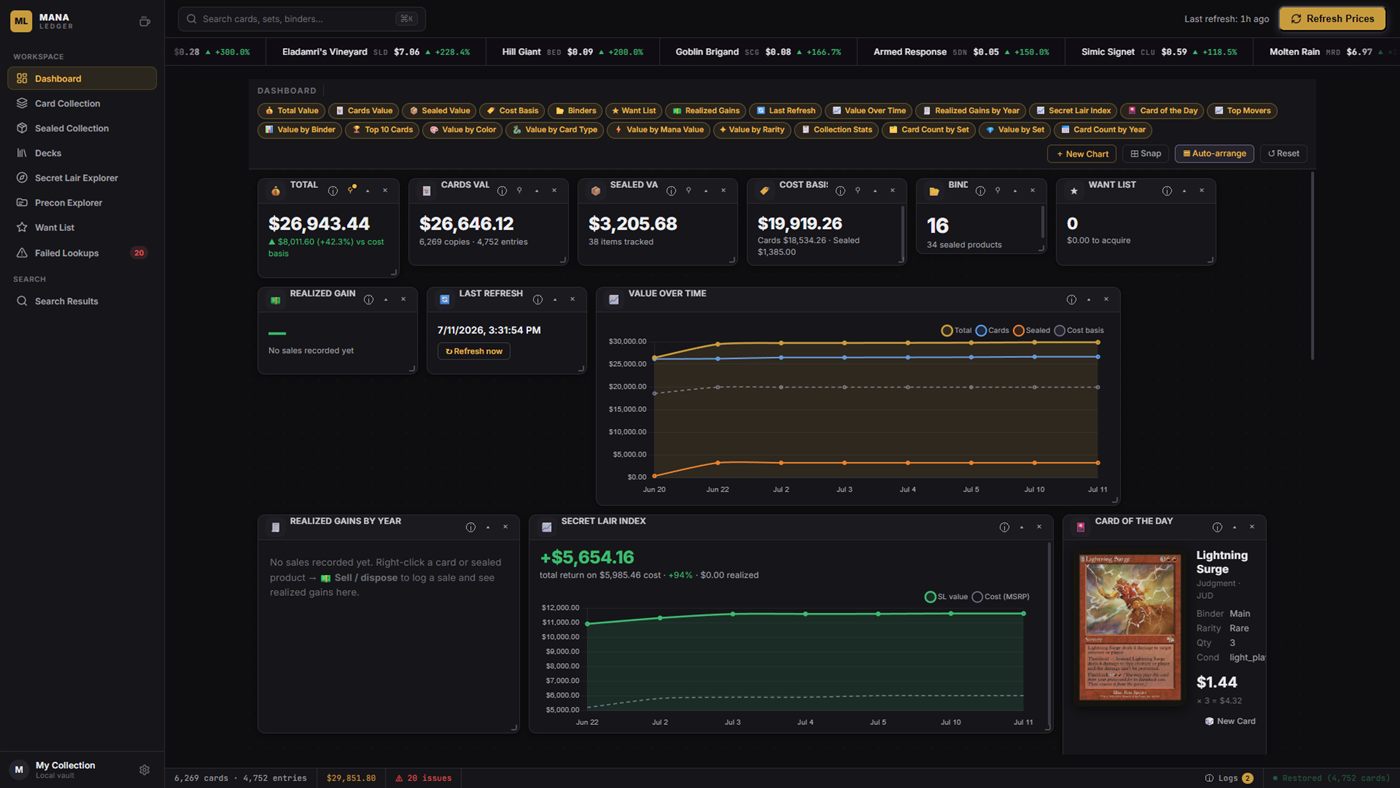
The financial terminal for your Magic: The Gathering collection — built around Secret Lair drops and preconstructed decks.
Free forever · No account · Your data never leaves your PC · Coming soon to Steam
Mana Ledger models the drop and the deck as real products with a purchase price and a knowable value — so it answers what collectors actually ask: Which drops made me money? Should I crack this sealed one or keep it? Is the new drop worth buying at MSRP? What am I missing from decks I'm building?
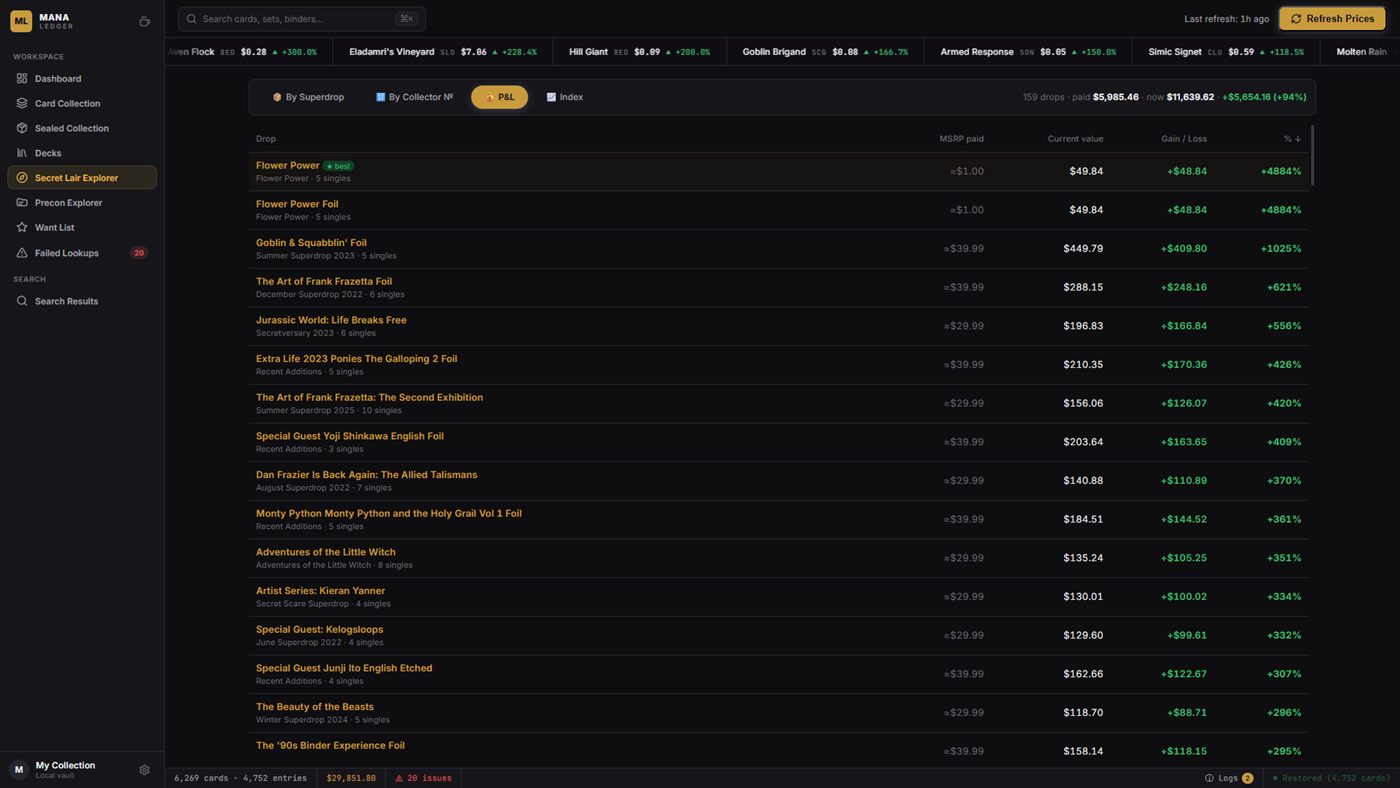
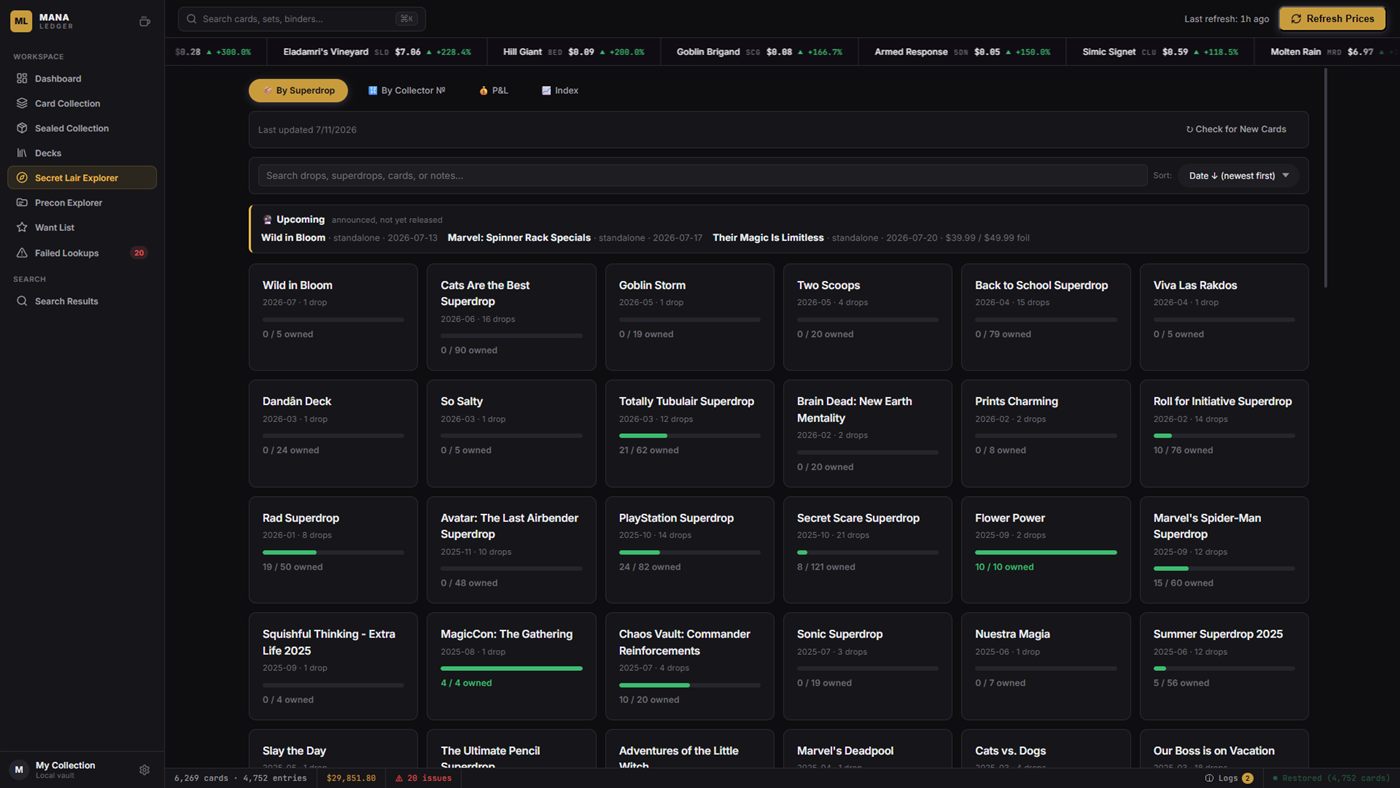
Every drop and superdrop, finish-aware. Product Truth and exact-completion reports, bundle cost allocation, bonus-pull journals, price watches, net crack-or-keep economics, cross-market comparisons, and a filterable/exportable SL Index.
Every preconstructed deck from 1993 to today with full decklists, ownership tracking, and "worth it?" pricing against singles and sealed markets.
Scryfall low + TCGplayer market on every card, optional exact-SKU CardTrader observations, price history sparklines, a daily bulk mode with zero rate limits, and sources that fail soft instead of crashing.
Table and gallery views, color and binder filters, sold/realized-gains tracking, deck format legality, and Moxfield / Archidekt / ManaBox / MTG Arena import-export.
Turn any incomplete drop or deck into a shopping list with per-card target prices — the price watch flags anything at or under target after each refresh.
One SQLite file on your machine with verified daily backups and one-click restore. No account, no cloud, no telemetry — see the privacy statement below.
Mana Ledger collects nothing. There is no account, no telemetry, no analytics, and no crash-reporting service. Your collection lives in a single database file on your own machine and never leaves it. The only network traffic is fetching public card data and prices (Scryfall, MTGJSON, TCGCSV, mtg.wiki, public Wizards announcements, and — only if you add your own paid token — PriceCharting or CardTrader); these requests carry no personal information. Update checks contact GitHub (or are handled by Steam on the Steam build). Feedback is only ever sent when you explicitly write and submit it yourself, and contains only what you typed.